Industrial piping systems rely on properly selected components to maintain efficient flow, accommodate changes in pipe size, and support reliable operation. One important component used to connect pipes of different diameters is the swage fitting. Available in concentric and eccentric configurations, swages allow piping systems to transition between different pipe sizes while meeting specific design and installation requirements.
Understanding the differences between concentric and eccentric swages can help engineers, contractors, and industrial purchasing professionals select the right fitting for their applications.
What Is a Swage in Industrial Piping?
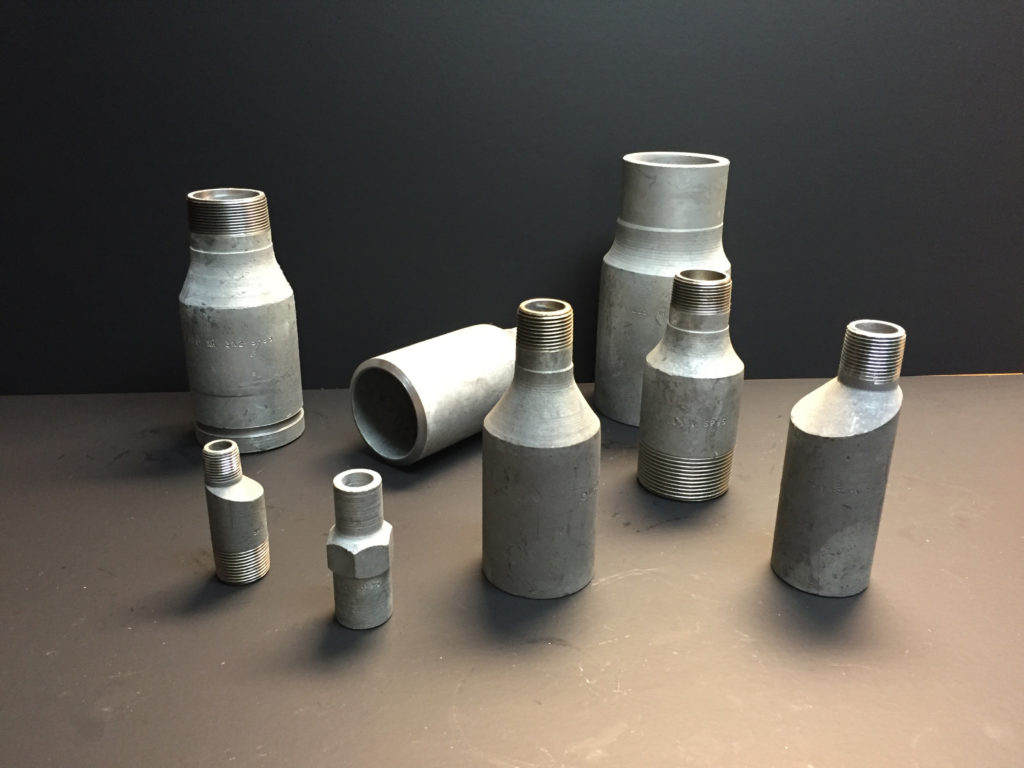
A swage is a pipe fitting designed to connect two different pipe sizes. It provides a transition between a larger pipe and a smaller pipe without requiring multiple fittings to accomplish the same connection.
Swages are commonly used in industrial piping systems where space, flow requirements, and connection configurations must be considered. Depending on the application, they may be specified with threaded, plain, beveled, or grooved ends.
For industrial environments where corrosion protection is important, hot-dipped galvanized swages offer a protective zinc coating designed to help reduce corrosion of the underlying steel.
What Is a Concentric Swage?
A concentric swage reduces pipe size while maintaining a common centerline between the larger and smaller ends. The transition is symmetrical, meaning the fitting tapers evenly around its center axis.
This configuration is often selected when the piping layout requires a centered transition between two pipe diameters.
Common considerations for concentric swages include:
Maintaining a common centerline between connected pipes
Transitioning between different nominal pipe sizes
Accommodating piping layouts where symmetrical geometry is preferred
Connecting piping components within industrial process and utility systems
Concentric swages can be useful in applications where the alignment of the connected piping is more important than maintaining a flat side along the transition.
What Is an Eccentric Swage?
An eccentric swage also connects pipes of different diameters, but its ends are offset rather than centered on the same axis. This creates a transition with one side that remains relatively flat.
The offset design allows the fitting to accommodate piping layouts where maintaining a particular elevation or alignment is necessary.
Eccentric swages may be considered when:
The piping layout requires one side of the connection to remain aligned
Space or equipment arrangement limits how the transition can be installed
The system design requires a specific elevation relationship between connected pipes
Engineers need to account for drainage, venting, or flow conditions in the overall piping arrangement
The appropriate orientation depends on the system design. Engineers must consider the service, flow direction, and installation requirements rather than selecting an eccentric swage based on geometry alone.
Concentric vs. Eccentric Swages: Key Differences
The primary difference between these two fittings is how they align the connected pipes.
Concentric swages provide a symmetrical transition around a common centerline. Eccentric swages offset the centerlines to maintain a flatter profile along one side of the fitting.
Neither configuration is universally better. The correct choice depends on the piping layout, equipment connections, and engineering specifications.
Before selecting a swage, buyers should verify the required pipe sizes, wall thickness, material specification, end connections, and orientation. These details help ensure the fitting is compatible with the rest of the piping system.
Material, Schedule, and Connection Considerations
In addition to choosing between concentric and eccentric designs, it is important to confirm the fitting’s material and dimensional requirements.
Industrial swages may be specified according to wall thickness, material grade, and end configuration. Depending on the application, the required ends may be threaded, plain, beveled, or grooved, or a combination of these configurations.
Hot-dipped galvanized swages can provide an added layer of corrosion protection in suitable applications. However, buyers should verify that the coating, base material, dimensions, and connection method meet the project’s requirements.
Accurate specifications are particularly important when sourcing fittings for industrial maintenance, new construction, and replacement projects.
Find Hot-Dipped Galvanized Swages at Tubespec
Choosing the correct swage fitting helps ensure a piping system is assembled according to its intended design. Understanding the differences between concentric and eccentric swages makes it easier to identify the appropriate configuration for a particular installation.
Tubespec has served the piping industry since 1989 as a master distributor specializing in hot-dipped galvanized pipe and piping products. Our swage inventory includes concentric and eccentric configurations in XH, S160, and XXH wall thicknesses, with threaded, plain, beveled, and grooved end options. Available sizes range from 1/8 inch through 6 inches, with material specifications including A234 WPB and WPL6.
Whether you are sourcing swages for a new industrial piping system or an existing installation, Tubespec can help you identify products that align with your project’s specifications.
Contact Tubespec to learn more about our hot-dipped galvanized swages and other industrial piping products.